Tiny Dark Specks in Your Aluminum Sample — Embedded SiC, and How to Stop It
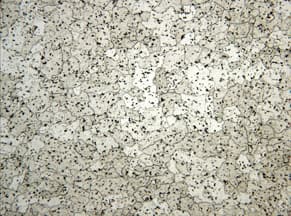
You finish a clean polish on aluminum, look at the surface, and notice a scatter of small dark dots distributed across the field. They do not move when you increase the etch time. They do not align with any feature of the microstructure. They are about 5–20 µm across, and they are everywhere.
These are embedded SiC particles, and they are particularly common on aluminum, lead, tin, magnesium, and zinc — any soft, ductile metal. Many operators see them and conclude that something is wrong with the polishing. The actual cause happened steps earlier, during grinding.
Why it happens
Silicon carbide papers are not perfectly bonded. Under polishing pressure, individual SiC particles can break loose from the paper and become free abrasive. On a hard matrix like steel, free SiC just gets flushed away by the water. On a soft matrix like aluminum, the free particle gets pressed into the soft surface by the pressure of the next pass and lodges there permanently. No subsequent polishing step can lift it out — diamond polishing pushes it deeper, and chemo-mechanical polishing dissolves the matrix around it but leaves the SiC sticking up like a tooth.
The problem is most severe at the last few SiC grits — P800, P1200 — because the smaller particles embed more easily into a smoother, less-resistant surface.
The diagnostic question
Are you using SiC papers or alumina papers in grinding? If SiC and your matrix is soft non-ferrous, the embedded specks are almost certainly liberated SiC.
How to confirm
Two quick checks:
- Switch to oblique illumination. SiC particles are dark gray to black, much darker than typical inclusions or precipitates in Al.
- SEM/EDS will show silicon and carbon at the dark spots if you have access. Conclusive.
The fix: change the abrasive
This is one of the rare prep problems where the proper fix is not a polishing change but an abrasive change:
- Switch to alumina (Al₂O₃) papers for the entire grinding ladder on soft non-ferrous samples. Alumina particles are bonded more strongly into the paper backing and resist liberation. They are also softer than SiC, which reduces embedment depth even when liberation does occur.
- Use diamond grinding films instead of SiC papers. The diamond is bonded into a polymer film that releases very few free particles. This is the cleanest option and is standard for high-quality MMC and electronics work.
- If you must use SiC for legacy or cost reasons, use fresh paper for every sample, lower the grinding force (15–20 N instead of 25–30 N), and skip the finest SiC grits (P800, P1200) in favor of starting on diamond at 9 µm directly after P600.
What if the sample is already embedded?
If you only notice the embedment after polishing, you have limited options. The two that sometimes work:
- Vibratory polish with colloidal silica for 1–4 hours. The very low force and long contact time can tip out shallowly-embedded particles. Deep embedment (lateral pressure during grinding) is not recoverable this way.
- Re-prep starting from grinding, switching to alumina or diamond films from the beginning. This is the reliable fix and usually faster than fighting embedded particles through a long vibratory cycle.
The lesson
Embedment is not a polishing problem; it is a grinding-abrasive problem. The choice of abrasive should match the matrix hardness — SiC is appropriate for steel and harder, but alumina or diamond is the right choice for soft non-ferrous metals. Once you pick the correct grinding abrasive, the embedded-speck problem disappears entirely.
For more on grinding abrasive selection, see the Grinding Techniques guide. For aluminum-specific recipes, see the Aluminum Sample Preparation guide.
Want to Learn More?
Explore our comprehensive guides for detailed step-by-step instructions on sample preparation techniques.
Browse GuidesRelated Posts

Pull-Out vs. Real Porosity — Reading the Pit, Not Just Counting Pits
Smooth, rounded pits are the original sample. Irregular, fresh-fracture pits are prep damage. Mistaking one for the other can mean a wrongly-rejected casting or a wrongly-accepted bad weld.
Read More
Comet Tails Behind Hard Particles — Diagnosing and Fixing Drag Damage
Comet tails are the visual signature of hard particles dragged across a soft matrix during polishing. The fix is force, rotation, and pad selection — not more polishing time.
Read More
Mirror Finish, No Etch Reaction — The Smearing Problem in Soft Metals
When the surface is mirror-bright but the etchant refuses to reveal anything, you have a smeared subsurface layer. Mechanical polishing flattened the deformation but left it in place.
Read More