Why Your Edges Are Rounded — and the One Mount Change That Usually Fixes It

Edge rounding is the single most expensive prep defect in failure analysis and case-depth work. It eats the first 10–50 µm of the sample — exactly where coatings, case-hardened layers, decarburization, and crack initiation sites live. If you see "the coating disappears as the field of view approaches the mount," or "near-edge grains look blurred in SEM," or "thickness measurements drift between operators," you are looking at edge rounding.
The frustrating part is that operators usually try to fix it at the polishing step, where it shows up. The actual cause is upstream.
The diagnostic question
Before changing anything, ask: What is the mount made of, and how long is the final polish step?
Two cause families dominate. Mount-material differential is by far the more common.
Cause 1: Mount is much softer than the sample
Compression-mounted phenolic ("Bakelite") is significantly softer than steel, stainless, superalloys, and most coatings. During polishing, the polishing pad — particularly napped chemotextile pads at the final step — conforms to the soft mount and lifts away from the harder sample at the edge. The result is a gradual chamfer over 10–50 µm.
The fix is to mount in a material whose hardness matches the sample more closely:
- Glass-filled epoxy thermosets are the gold standard for edge retention. Glass particulate keeps the mount stiff and resistant to differential wear.
- Diallyl phthalate is harder than phenolic and a good middle-ground choice for general work.
- Castable epoxy with vacuum impregnation handles porous samples and thermal-spray coatings where compression mounting would crush the structure.
Cause 2: Final polish is too long on too soft a pad
Even with a perfect mount, an extended final polish — say 5+ minutes on a chemotextile pad with colloidal silica — gives the pad time to conform and round the edge. Tighten the final step to 60–90 seconds plus a 30-second water flush. If you cannot get a clean surface in that time, the upstream steps left damage that the final step is now trying (and failing) to remove.
Cause 3 (rarer): Rotation direction
You will see vendor literature recommend counter-rotation as the default for edge retention. The truth is more nuanced: PACE generally prefers co-rotation (head and platen turning the same direction) because it runs gentler and distributes pressure more evenly. Counter-rotation can be a useful experiment if mount and pad changes have not fully resolved the problem, but it is not the primary lever.
The proper fix
For routine work that needs decent edge retention: glass-filled epoxy compression mount, 5–7 minute hot-mount cycle, cooled under pressure. This combination eliminates the problem at its source so the polishing recipe does not have to compensate.
For coatings, thermal sprays, and electronic die packages where edge retention is paramount: castable epoxy with vacuum impregnation, then a hard pad through the entire ladder including the final step (synthetic suede instead of chemotextile), and a final polish kept under 2 minutes.
Quick-fix checklist
- Switch from phenolic to glass-filled epoxy or diallyl phthalate.
- Cap final polish at 90 seconds + 30 second water flush.
- Use a harder final-step pad (synthetic suede) before reaching for chemotextile.
- If still rounding after the above, try counter-rotation as a tunable.
For a deeper read on when each mount family is appropriate, see the Metallographic Mounting guide. For case-depth measurement protocols specifically, see the Heat Treatment Verification guide.
Want to Learn More?
Explore our comprehensive guides for detailed step-by-step instructions on sample preparation techniques.
Browse GuidesRelated Posts

Pull-Out vs. Real Porosity — Reading the Pit, Not Just Counting Pits
Smooth, rounded pits are the original sample. Irregular, fresh-fracture pits are prep damage. Mistaking one for the other can mean a wrongly-rejected casting or a wrongly-accepted bad weld.
Read More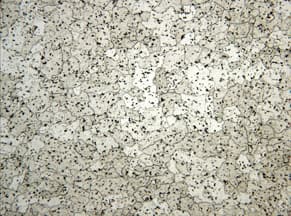
Tiny Dark Specks in Your Aluminum Sample — Embedded SiC, and How to Stop It
Those random dark dots on your polished Al, Pb, Sn, or Mg sample are loose silicon carbide grit ground into the surface. The fix is changing your grinding abrasive, not your polishing.
Read More
Comet Tails Behind Hard Particles — Diagnosing and Fixing Drag Damage
Comet tails are the visual signature of hard particles dragged across a soft matrix during polishing. The fix is force, rotation, and pad selection — not more polishing time.
Read More